
Lumbar Spinal Stenosis
Do I Need Surgery?
If you’ve been diagnosed with lumbar spinal stenosis, you may be wondering:
“Do I need surgery?”
This is one of the most common questions patients ask after receiving an MRI report showing narrowing in the lower spine.
What Is Lumbar Spinal Stenosis?
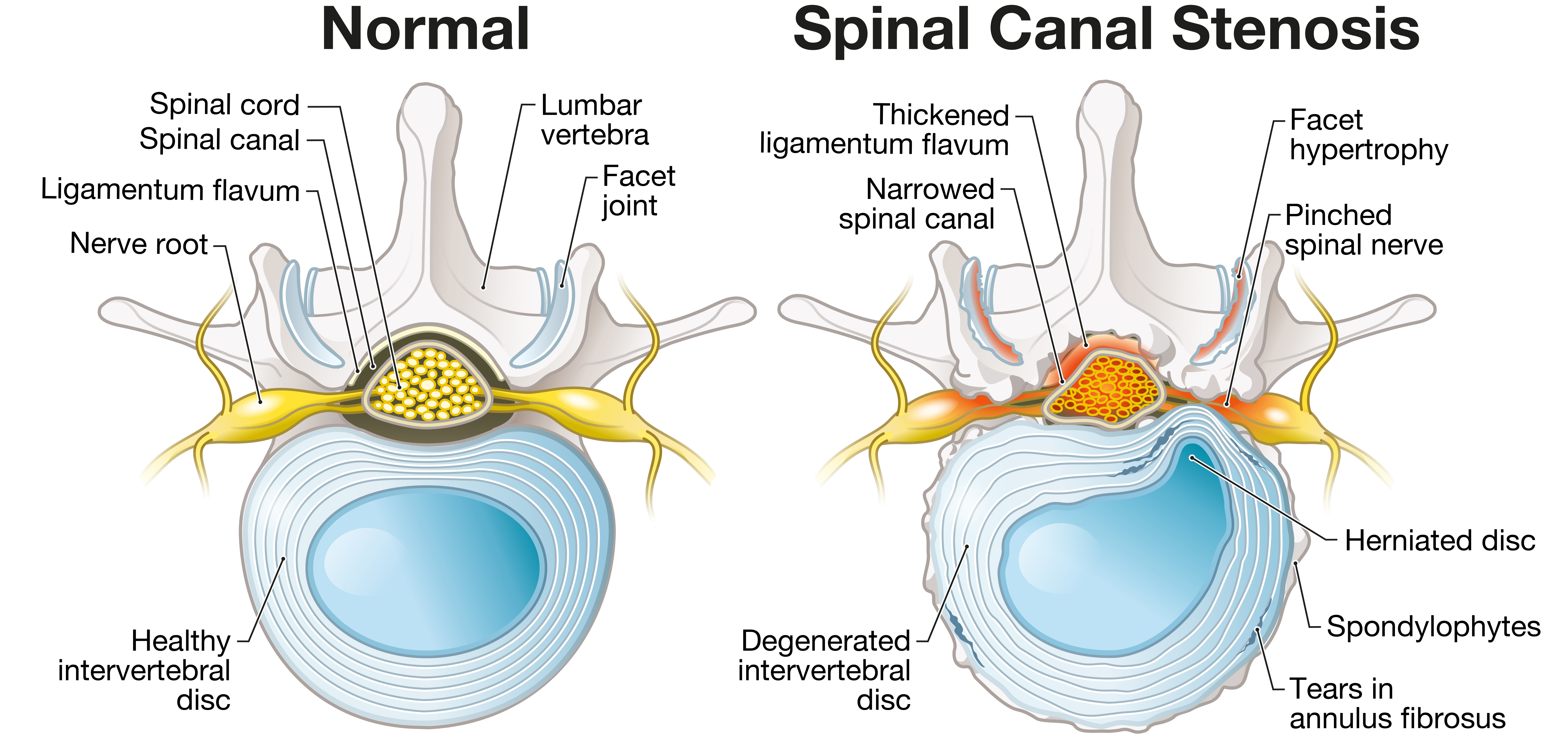
Lumbar spinal stenosis refers to a narrowing of the spinal canal in the lower back. This narrowing can compress the spinal nerves that travel into the legs.
It commonly develops due to age-related changes, including:
- Degenerative disc changes
- Thickened ligaments
- Arthritic facet joints
- Bony overgrowth
It is most frequently diagnosed in adults over 60.
Does It Always Cause Symptoms?
No.
Imaging studies in older adults show that approximately 20% of people over the age of 60 have MRI evidence of lumbar spinal stenosis without any symptoms.
That means 1 in 5 patients may have MRI findings of lumbar canal stenosis and feel completely well.
An MRI finding alone does not automatically mean treatment — especially surgery — is required.
What Are the Symptoms of Lumbar Canal Stenosis?
The hallmark symptom is difficulty walking.
Typical symptoms include:
- Leg pain or heaviness when walking
- Numbness or tingling in the legs
- Weakness after standing for a period
- Relief when sitting or bending forward
Many patients describe being able to walk only a short distance before needing to stop.
This pattern is known as neurogenic claudication.
Is Lumbar Spinal Stenosis Dangerous?
Lumbar spinal stenosis is rarely dangerous.
However, urgent medical attention is required if you experience:
- Loss of bladder or bowel control
- Severe or rapidly worsening leg weakness
- Numbness in the saddle area
These symptoms are uncommon but require immediate assessment.
When Is Lumbar Spinal Stenosis Surgery Not Indicated?
Lumbar spinal stenosis surgery is indicated to improve function — not to “treat a scan.”
Surgery is generally not recommended in the following situations:
1. When Symptoms Are Mild or Acceptable
If symptoms are:
- Intermittent
- Mild in severity
- Not significantly limiting walking or daily activities
- Stable or acceptable to the patient
Many patients can manage successfully with:
- Physiotherapy
- Activity modification
- Pain management
- Observation
2. When Back Pain Is the Main Symptom
Decompression surgery is designed to relieve nerve pressure, which primarily improves:
- Leg pain
- Walking intolerance (neurogenic claudication)
If the dominant symptom is mechanical lower back pain, surgery for stenosis alone may not provide meaningful benefit.
Back pain related to degeneration often requires a different management approach.
3. When Conservative Treatment Has Not Been Tried
In most cases, surgery is considered only after:
- Structured physiotherapy
- Appropriate medical management
- Allowing time for natural progression to stabilise
Unless symptoms are severe or progressive, a period of non-operative treatment is appropriate.
4. When Medical Risk Outweighs Benefit
In some patients with significant medical comorbidities, surgical risk may outweigh potential benefit.
In such cases, conservative management may be preferable.
When Is Surgery Recommended?
Typically, less than one third of patients over several years of follow-up may require surgery.
Surgery may be considered if:
- Walking distance becomes severely restricted
- Symptoms persist despite appropriate conservative treatment
- There is progressive leg weakness
- Quality of life is significantly affected
The most common operation is a lumbar decompression, which aims to relieve pressure on the nerves.
When carefully selected, spinal stenosis surgery can significantly improve mobility and leg symptoms.
Is Surgery Safe?
Studies consistently show that:
- Around 70–80% of appropriately selected patients experience significant improvement in leg symptoms
- Walking distance often improves substantially
- Quality of life scores improve in most patients
- Leg pain improves more reliably than back pain
Success is highest when surgery is performed for:
- Leg pain (neurogenic claudication)
- Clear nerve compression on MRI
- Symptoms limiting mobility
Key Takeaway
Lumbar spinal stenosis surgery is indicated to improve function — not to treat an MRI scan.
Many people with lumbar canal stenosis manage well without surgery.
If walking has become progressively limited, a specialist assessment can clarify whether conservative care remains appropriate — or whether surgery would meaningfully improve your quality of life.
The goal is always the same:
To restore mobility and confidence, with intervention only when clearly justified.
References
- Weinstein JN, Tosteson TD, Lurie JD, et al.
Surgical versus nonoperative treatment for lumbar spinal stenosis. New England Journal of Medicine. 2008;358(8):794–810. - Weinstein JN, Lurie JD, Tosteson TD, et al.
Long-term outcomes of surgical and nonoperative management of lumbar spinal stenosis: 8-year results for the SPORT trial. Spine. 2015;40(2):63–76. - Försth P, Ólafsson G, Carlsson T, et al.
A randomised, controlled trial of fusion surgery for lumbar spinal stenosis. New England Journal of Medicine. 2016;374:1413–1423. - Zaina F, Tomkins-Lane C, Carragee E, Negrini S.
Surgical versus non-surgical treatment for lumbar spinal stenosis. Cochrane Database of Systematic Reviews. 2016;(1):CD010264. - Kreiner DS, Shaffer WO, Baisden JL, et al.
Evidence-based clinical guideline for degenerative lumbar spinal stenosis. The Spine Journal. 2013;13(7):734–743. - National Institute for Health and Care Excellence (NICE).
Low back pain and sciatica in over 16s: assessment and management (NG59). London: NICE; 2016 (updated guidance as applicable).
Specialist Spine Assessment
If you are experiencing:
- Persistent leg pain
- Heaviness when walking
- Symptoms suggestive of lumbar spinal stenosis
A specialist assessment can help determine the most appropriate course of treatment.
Consultant-led spine care focuses on:
- Careful diagnosis
- Evidence-based management
- Recommending intervention only when it is likely to meaningfully improve mobility and quality of life
Appointments can be arranged via: contactspinecare.uk@gmail.com
07771112322
.png)